What is Ultrafiltration Water System Featured at 139th Canton Fair?
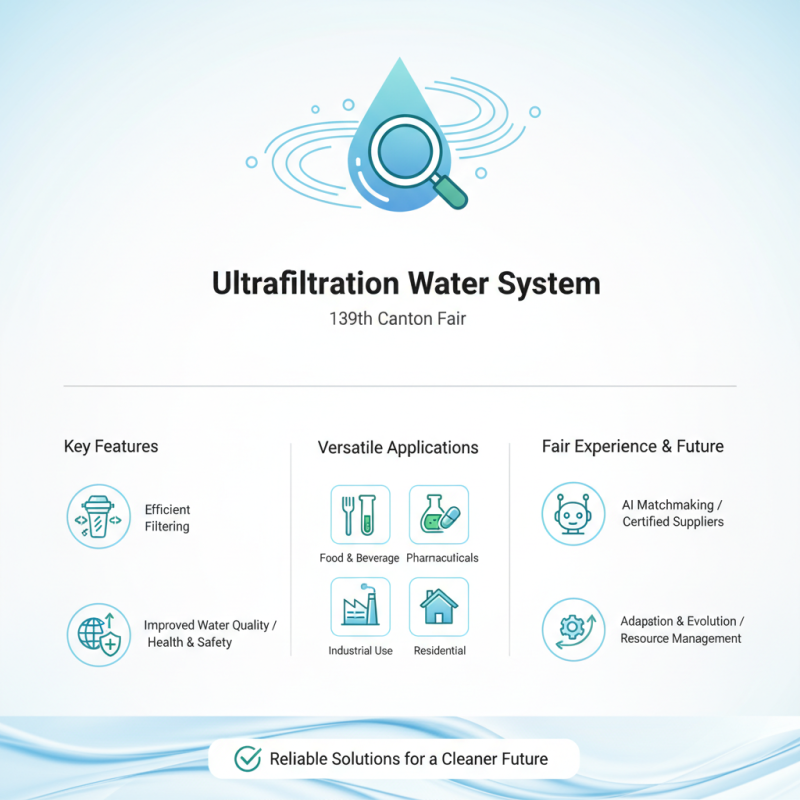
The 139th Canton Fair is set to showcase the Ultrafiltration Water System, a cutting-edge water purification technology. This system offers efficient filtering capabilities that can significantly improve water quality. As global demand for clean water continues to rise, innovations like this are crucial.
Attendees will have the chance to explore various applications of the Ultrafiltration Water System. It plays a vital role in industries ranging from food and beverage to pharmaceuticals. With an emphasis on health and safety, its features may attract many buyers searching for reliable solutions.
The introduction of AI technology will enhance the experience for attendees. Buyers can easily locate suppliers with the required certifications, ensuring a productive visit. However, the fair also presents challenges. Companies should be prepared to adapt and reflect on their offerings. Efficient use and management of resources remain essential as water purification technology evolves.
Overview of Ultrafiltration Water Systems
Ultrafiltration water systems are gaining popularity for their efficiency and sustainability. These systems work by utilizing membrane technology to remove impurities. They can filter out particles as small as 0.01 microns. This capability allows them to eliminate bacteria, viruses, and contaminants. The result is clean, safe water for various applications.
At the 139th Canton Fair, ultrafiltration systems showcased their potential. Visitors observed the seamless design and user-friendly interfaces. Some prototypes even incorporate smart technologies. Yet, there remain questions about long-term maintenance. Membranes can require replacement, especially in areas with high sediment levels. Without proper care, performance may decline.
Educational efforts are crucial. Many potential users may not understand the technology fully. The benefits are clear, but misconceptions linger. For example, some believe ultrafiltration is just another filtration method. In reality, it provides more thorough purification. It’s essential to highlight these distinctions. Understanding encourages better adoption and utilization.
Key Features and Technologies Highlighted at the Canton Fair
The 139th Canton Fair presented an array of advanced technologies, particularly in ultrafiltration water systems. These systems use membranes to separate particles and contaminants from water. This results in cleaner, safer water for various applications. Many booths showcased innovative designs aimed at improving efficiency and effectiveness.
Key features of these systems include energy efficiency and compact design. Several models were smaller than previous generations, making them easier to install in diverse environments. Additionally, the filtration process is quick, providing purified water on demand. However, some attendees pointed out that maintenance could be challenging due to the complexity of certain components.
Another interesting aspect was the integration of smart technology. Many systems offer real-time monitoring, allowing users to track performance easily. Yet, some features might seem overwhelming for those unfamiliar with advanced tech. This learning curve could hinder broader acceptance among potential users. Overall, the ultrafiltration systems highlighted at the fair represent a significant step forward, but there is still room for improvement in user experience.
Benefits of Ultrafiltration in Water Purification
Ultrafiltration (UF) is an advanced water purification method. It uses a semi-permeable membrane to remove impurities, bacteria, and suspended solids. This process is efficient and eco-friendly. Many people appreciate that it operates without harsh chemicals. As a result, the water retains essential minerals.
Another benefit of ultrafiltration is its versatility. It can be used in various settings, from homes to industries. It adapts to different water qualities. However, this system is not perfect. Maintenance is crucial. Filters must be replaced regularly to function optimally. Users sometimes overlook this aspect, leading to less effective purification.
Additionally, ultrafiltration systems require a source of pressure to work. This might limit accessibility for some users. Energy consumption for some models is another point for consideration. Still, the clarity and safety of purified water make UF systems highly desirable. It's essential to weigh both the benefits and challenges of this technology.
Applications of Ultrafiltration Systems in Various Industries
Ultrafiltration (UF) systems are gaining traction across multiple sectors due to their efficiency in water treatment. In the food and beverage industry, these systems effectively remove contaminants while retaining essential nutrients. A recent report from the International Water Association highlighted that the UF market is projected to grow by 10% annually through 2026. This growth stems from increasing demand for clean water and stringent regulations.
In municipal water treatment, UF plays a crucial role in ensuring safe drinking water standards. The World Health Organization has noted that ultrafiltration can eliminate almost 99% of pathogens. However, not all facilities implement these systems effectively. Many struggle with the cost and maintenance involved. Operators often face challenges in replacing membranes, which can be costly and complex.
Industries like pharmaceuticals also benefit from UF technology. The ultrafiltration process helps meet stringent quality requirements. However, the adaptation rate is uneven. Some companies hesitate to invest in new technology due to budget constraints. A survey indicated that 45% of pharmaceutical plants are still relying on outdated systems. This could pose risks to product quality and safety. Embracing ultrafiltration could bridge this gap.
Comparative Analysis with Other Water Filtration Methods
Ultrafiltration (UF) water systems are gaining traction as effective filtration methods showcased at events like the 139th Canton Fair. They utilize membranes with pore sizes ranging from 0.1 to 0.001 microns, efficiently removing bacteria, viruses, and colloidal particles. This level of filtration can yield water with a turbidity of less than 1 NTU, meeting stringent potable water standards. According to recent market analysis, the global ultrafiltration membrane market is projected to grow by 9.4% annually through 2027.
Comparatively, traditional filtration methods, such as reverse osmosis (RO), focus primarily on dissolved solids. RO systems can remove numerous contaminants, but they often waste 3 to 5 gallons of water for every gallon purified. On the other hand, UF systems consume less energy and do not require extensive pre-treatment. A report by the Water Quality Association highlights UF's lower operational costs, making it more sustainable for both residential and industrial applications. However, a common drawback is their inability to remove certain dissolved salts, which may be a concern in specific areas.
These nuances require careful consideration. While UF offers excellent microbial removal, it does not completely substitute RO or activated carbon filters. Users need to weigh their specific water quality needs against what UF can deliver. Many still overlook these factors, leading to less optimized water choices. Ultimately, the evolution of water filtration is a testament to advancing technology, but it is imperative to remain critical of its limitations.